
Introduction
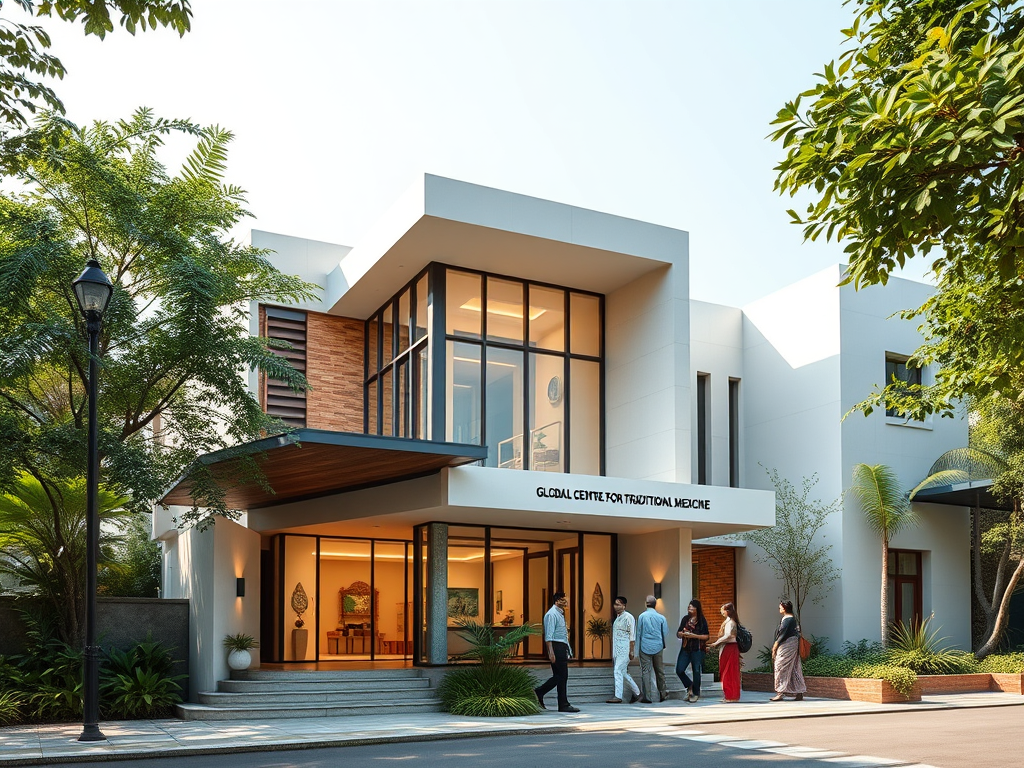
Traditional medicine has been practiced across cultures for centuries, providing primary healthcare to large segments of the global population. In recent decades, interest in these systems has resurged, driven by increasing healthcare costs, cultural preferences, and the search for holistic well-being. Ayurveda, India’s most prominent traditional medical system, has gained global recognition as both a health practice and a growing economic sector. In March 2022, the World Health Organization (WHO), in partnership with the Government of India, inaugurated the Global Centre for Traditional Medicine (GCTM) in Jamnagar, Gujarat. This center seeks to integrate traditional medicine within the global health framework by building evidence, developing quality standards, and enabling export readiness (WHO, 2022a).
Establishment of the WHO Global Centre for Traditional Medicine
The establishment of the GCTM is a landmark in global health governance. It is WHO’s first global center dedicated solely to traditional medicine and represents a collaboration in which India has committed more than USD 250 million for infrastructure and operations (Press Information Bureau [PIB], 2022). Situated on a 35-acre campus, the GCTM is mandated to serve as a knowledge hub, supporting research, policy, and innovation in traditional medicine. Its creation acknowledges that nearly 80% of the world’s population relies on some form of traditional medicine, underscoring the need for global frameworks that ensure safety, efficacy, and quality (WHO, 2023b).
Evidence and Research
The central challenge facing Ayurveda and other traditional systems lies in building a robust evidence base. While historical use and community knowledge are extensive, modern healthcare integration demands validated safety and efficacy. WHO has emphasized the application of methodologies such as systematic reviews, randomized controlled trials, ethnopharmacology, and reverse pharmacology to evaluate traditional practices (WHO, 2023b). This research orientation is also aligned with WHO’s Traditional, Complementary, and Integrative Medicine Strategy 2025–2034, which places evidence-based evaluation at the core of global acceptance (WHO, 2025a).
By linking research institutions, the GCTM aims to harmonize knowledge, create databases of medicinal plants, and encourage innovation through digital technologies, including artificial intelligence and bioinformatics.
Standards and Regulation
Standardization and regulatory frameworks are essential for scaling Ayurveda globally. The GCTM plays a normative role by supporting WHO member states in drafting standards, guidelines, and technical documents on training, practice, and product quality. Compliance with Good Manufacturing Practices (GMP) has been emphasized as a prerequisite for safe global trade. Recent state-level data illustrate this trend; for example, Gujarat alone approved 200 new Ayurvedic manufacturing units between 2021 and 2025, all compliant with GMP standards (Times of India, 2025).
Such initiatives are designed to mitigate persistent challenges, including variability in product quality, adulteration, and inconsistent labeling, which have undermined global confidence in herbal medicines.
Export Markets and Economic Potential
The economic promise of Ayurveda is significant. India’s broader pharmaceutical exports exceed USD 22 billion annually, while herbal and natural product exports are expanding rapidly, particularly in post-COVID markets emphasizing immunity and preventive care (India Brand Equity Foundation [IBEF], 2022). Projections suggest the global herbal medicine market will continue its robust growth trajectory, offering India opportunities to position itself as a leader in evidence-backed, regulated herbal products.
The GCTM’s role in aligning Ayurvedic products with international pharmacopoeia standards and regulatory expectations is crucial. By addressing non-tariff barriers and ensuring quality, the center can unlock access to European, North American, and Southeast Asian markets, where demand for herbal and wellness products is surging (Sarwal, 2025).
Challenges
Despite these opportunities, Ayurveda’s global expansion faces challenges. First, scientific validation remains uneven, with limited high-quality clinical trials available for many therapies. Second, regulatory divergence across regions—such as the European Union’s stringent herbal medicine directives versus the relatively flexible U.S. dietary supplement framework—complicates export strategies. Third, biodiversity concerns loom large, as overharvesting of medicinal plants threatens ecological sustainability. Finally, intellectual property rights and benefit sharing pose ethical challenges, particularly regarding indigenous knowledge systems (Health Policy Watch, 2025).
Addressing these challenges will require collaboration across governments, scientific bodies, and industry, guided by principles of equity and sustainability.
Conclusion
The WHO Global Centre for Traditional Medicine in Gujarat represents a turning point for Ayurveda’s global trajectory. By prioritizing evidence, standards, and export readiness, the GCTM provides a platform for integrating Ayurveda into mainstream health systems without compromising scientific rigor. If its mandate is fulfilled, Ayurveda can become not only a cornerstone of India’s cultural diplomacy but also a reliable contributor to global health and economic growth. The center’s success will depend on its ability to balance tradition and science, ensuring that Ayurveda’s next chapter is both credible and sustainable.
References
Health Policy Watch. (2025, May 27). WHO’s big push to integrate traditional medicine into global healthcare framework. Health Policy Watch. https://healthpolicy-watch.news/whos-big-push-to-integrate-traditional-medicine-into-global-healthcare-framework/
India Brand Equity Foundation. (2022, May 5). WHO Global Centre for Traditional Medicine (GCTM). IBEF. https://ibef.org/blogs/who-global-centre-for-traditional-medicine-gctm
Press Information Bureau, Government of India. (2022, March 9). Cabinet approves establishment of WHO Global Centre for Traditional Medicine in India. PIB. https://pib.gov.in/PressReleasePage.aspx?PRID=1804289
Press Information Bureau, Government of India. (2023, August 17). WHO’s first ever Global Summit on Traditional Medicine inaugurated as part of the G20 Health Minister’s Meeting in Gandhinagar, Gujarat. PIB. https://pib.gov.in/PressReleaseIframePage.aspx?PRID=1949767
Sarwal, R. (2025). Export of evidence-based wellness services. Journal of Public Health Policy and Planning, 32(1), 55–68. https://pmc.ncbi.nlm.nih.gov/articles/PMC12149425/
Times of India. (2025, July 18). Gujarat sees 200 new Ayurvedic units in four years. The Times of India. https://timesofindia.indiatimes.com/city/ahmedabad/gujarat-sees-200-new-ayurvedic-units-in-four-years/articleshow/122671600.cms
World Health Organization. (2022a, March 25). WHO establishes the Global Centre for Traditional Medicine in India. WHO. https://www.who.int/news/item/25-03-2022-who-establishes-the-global-centre-for-traditional-medicine-in-india
World Health Organization. (2023b). First Traditional Medicine Global Summit 2023 meeting report: Towards health and well-being for all. WHO. https://pmc.ncbi.nlm.nih.gov/articles/PMC10692373/
World Health Organization. (2025a). WHO Global Traditional Medicine Centre: Overview. WHO. https://www.who.int/teams/who-global-traditional-medicine-centre/overview
Leave a Reply